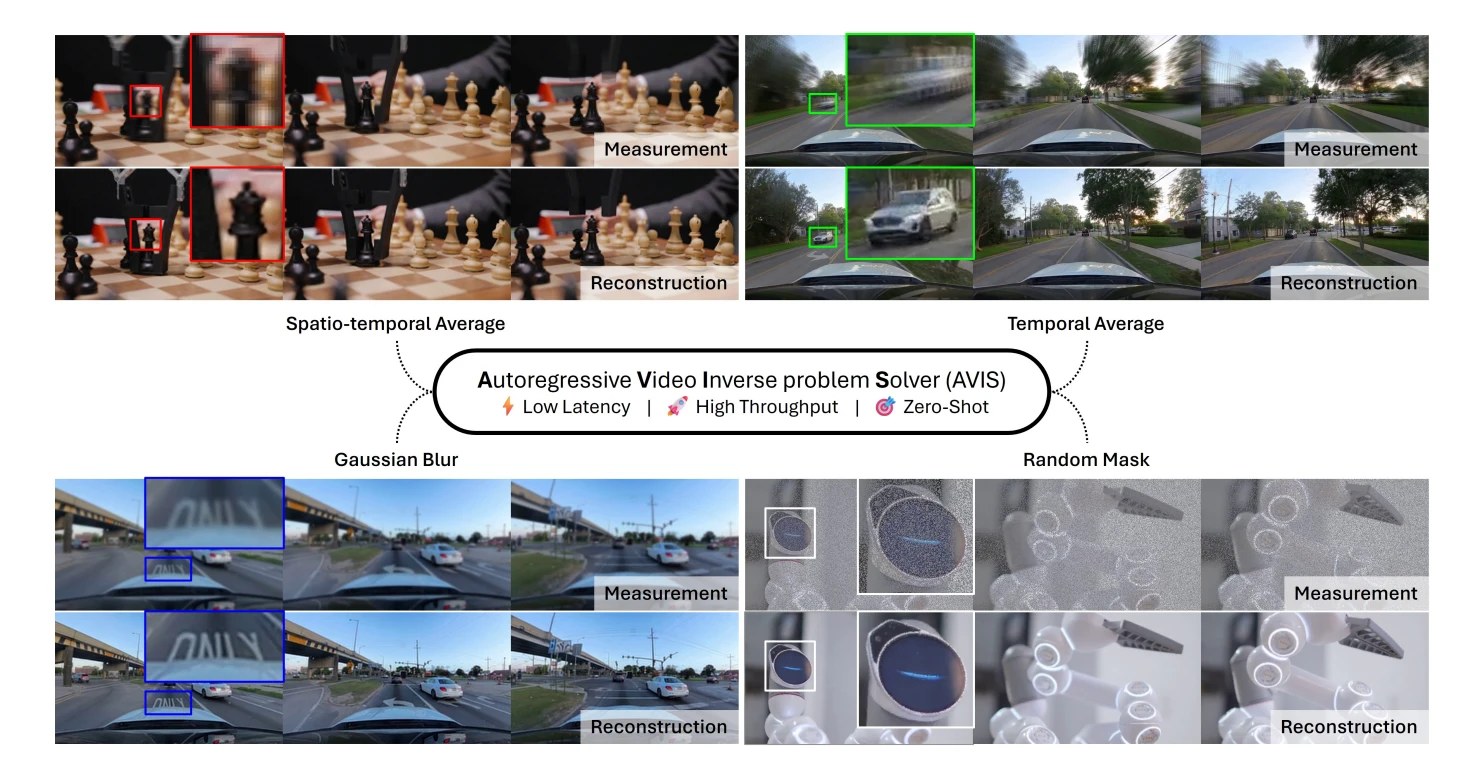
Accelerating Video Inverse Problem Solvers with Autoregressive Diffusion Models
News
About BISPL
BISPL —the Bio Imaging, Signal Processing, and Machine Learning Lab at KAIST AI — is led by Prof. Jong Chul Ye, an IEEE Fellow. Our research spans theory & reinforcement Learning (RL) for diffusion/flow Models, LLMs & agentic AI, vision-language-action (VLA) Models, world models, computer vision, AI for science & healthcare, and medical imaging.
Across these areas, we seek to uncover the mathematical beauty and fundamental principles of modern AI and translate them into real-world impact. We ask not only how AI works, but why it works, developing new theories and algorithms from challenging practical problems. Building on deep expertise in biomedical imaging, signal processing, inverse problems, and machine learning, we turn real-world applications into sources of fundamental insight—and fundamental advances into transformative technologies.
Explore our people, publications, and latest news.
Most Recent Publications
- [C108] Accelerated Image Editing via Consistency-Aware Source Token PruningIn Conference on Neural Information Processing Systems ( NeurIPS ), 2026
- [C107] MotionCFG: Boosting Motion Dynamics via Semantic Motion SharpeningIn Conference on Neural Information Processing Systems ( NeurIPS ), 2026